Professional Bespoke Enclosures Manufacturer Since 2007 - Hongfa Shunda
Language

Learn what sheet metal enclosures are, how manufacturers build them, and why they outperform plastic enclosures for industrial applications.
You've probably spec'd dozens of enclosures for electrical components, but can you really say what makes a sheet metal enclosure different from every other protective housing out there?
Most procurement teams treat enclosures as if they're all created equal - but that's a costly mistake. Sheet metal enclosures have specific advantages over plastic or cast alternatives - but only if you pick the right construction for your application.
So, here's what we'll be covering:
● The core definition and construction of sheet metal enclosures
● How sheet metal enclosure manufacturers put these protective housings together
● The key materials used in custom sheet metal enclosures
● The fundamental differences between custom-built metal enclosures and other enclosure types
We're cutting through the hype to give you a clear, honest understanding of what you're actually getting when you order a sheet metal enclosure box.
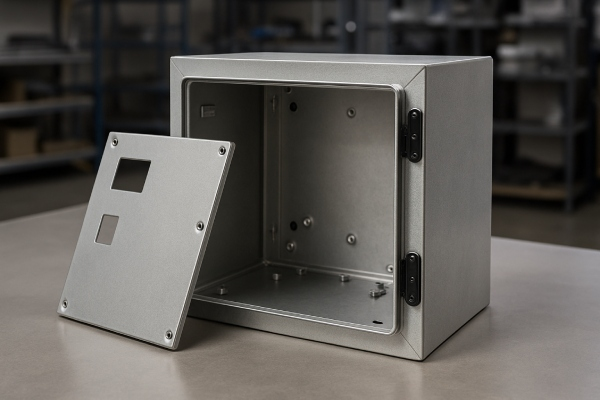
A sheet metal enclosure is basically a protective housing made from thin, flat metal sheets that get cut, bent, and assembled into a box-like structure. The metal sheets are usually anywhere from 0.5mm to 6mm thick, and that depends on how tough the job is and what kind of environment the enclosure will be in.
The construction process involves taking flat metal stock and turning it into a three-dimensional protective housing, the old-fashioned way - by forming it mechanically. Unlike cast or injection-molded enclosures, sheet metal enclosure manufacturers don't have to pour molten material into molds.
Here's what makes up a standard sheet metal enclosure box:
● Base plate - Just the bottom plate that holds the whole thing together
● Side panels - The vertical bits that form the enclosure's edges
● Top cover - An access panel that's either removable or hinged (and might even come with a seal)
● Mounting bits - Anything from simple fasteners to brackets and reinforcement ribs
● Cable entry points - Pre-drilled or custom knockouts for getting wires in and out
Most custom sheet metal enclosures are held together with welded or riveted seams in the corner joints. The method you choose affects the enclosure's durability, water-resistance and overall toughness.
Tip: If you think you're going to need to make changes down the line, go with riveted or bolted construction - it's a bit more flexible than welded.
Sheet metal enclosure manufacturers follow a multi-stage process that starts from a blank sheet and ends up with a finished protective housing ready to install. Design specs come first, then it's CAD, production, powder-coating, or paint at the end. Straightforward once you actually see how it works, pretty much.
Here's a basic rundown of how it all happens:
● Design and Engineering: CAD software turns your requirements into something that can actually be built. Engineers figure out things like bend allowances, material thickness, and where the knockouts should be—all before any metal gets cut.
● Cutting and Forming Operations:
○ Laser cutting or punch presses trim the metal sheets to size
○ CNC press brakes bend the flat panels into the right angles
○ Forming dies create weird curves or specialized shapes
○ Notching removes a bit of material to make bending easier
● Assembly and Joining the Pieces Together: Fabricators weld corners together to create permanent seams or use mechanical fasteners to make designs that can be taken apart for service. TIG welding is the way to go for a super-clean joint on aluminum enclosure boxes, while MIG welding is better for thicker steel construction is a better choice.
● Finishing Touches: The raw metal surfaces get a makeover with powder coating, liquid paint, or anodizing (for aluminum). These coatings help prevent corrosion and give the metal the look you want. Installing the hardware, like hinges and latches, happens last - after the coating is fully dry, the mounting plates and gaskets get screwed in.
Fabrication Method | Best For | Typical Lead Time |
Welded Construction | Outdoor/harsh environments | 2-4 weeks |
Riveted Assembly | Indoor applications | 1-2 weeks |
Bolted Panels | Modular/expandable systems | 1-3 weeks |
Those small-batch custom metal enclosures are usually more expensive per unit than big runs. The manufacturers try to recoup the costs of making those custom tooling things by selling the enclosures in bulk.
The material you choose will give your enclosure a certain weight, level of corrosion resistance, ability to block electromagnetic fields, and thermal performance. Sheet metal enclosure manufacturers typically work with these three materials.
This is the go-to material for a lot of industrial enclosures. Cold-rolled steel is strong and not too expensive, but it does rust if you don't give it a proper coating. You'll find it in control panels, equipment housings, and other places where weight isn't a problem.
It machines easily and holds up well to being made into whatever shape you need. Powder coating or liquid paint is enough to protect it from rust in most indoor situations.
Need corrosion resistance without relying on a layer of paint to stop it from rusting? Then stainless steel's your bet. Food processing places, coastal installations, and chemical plants all just use stainless steel enclosures because they don't rust like crazy
The catch is, though - this material is way more expensive than the cold-rolled steel you can pick up at the hardware store - we're talking 3 to 5 times more, and it can be a bit of a pain to weld properly. Types 304 and 316 are the most common grades on the market, and 316 has just a bit more resistance to corrosion if you happen to be building something that's going to be right by the sea
Going for an aluminum sheet metal enclosure can be a pretty sweet balance between strength and weight. If you can work with an aluminium enclosure manufacturer, it's dead easy to produce a housing that weighs a whole 60% less than the steel version and still manages not to fall apart. And one of the big advantages that aluminium has is that it's a great conductor of heat - so great that it's ideal for electronics that get scorching hot. Not to mention it's got a natural oxide layer that keeps corrosion at bay without needing any kind of extra coating, and anodising will make it even more resilient and look pretty nice too.
Here's how the materials compare:
Material | Weight | Corrosion Resistance | Cost | EMI Shielding |
Cold-Rolled Steel | Heavy | Poor (needs coating) | Low | Excellent |
Stainless Steel | Heavy | Excellent | High | Good |
Aluminum | Light | Very Good | Medium | Good |
Pro tip: If you need to block electromagnetic fields (EMI), steel does a better job than aluminum - despite aluminum's other advantages. Steel has a higher magnetic permeability, which means it does a better job of blocking those fields.
Sheet metal fabrication has to compete with three other major ways to make enclosures: injection molding, die casting, and fiberglass construction. Each of these methods has its own trade-offs in terms of customization, cost, and performance.
Plastic junction boxes and ABS plastic enclosures rule the low-cost, high-volume game. A plastic enclosure box is cheaper to make in bulk because you can spread the cost of the tooling across thousands of units.
But custom plastic junction boxes have some limitations. For one thing, they can't take the same heat as metal enclosures - most thermoplastics start to soften around 80-120°C. And when it comes to impact resistance, drop a plastic junction box from waist height onto concrete, and it'll likely crack the housing. A sheet metal enclosure box, on the other hand, might dent, but the structure will still be fine.
Another thing to consider is that it's tough to customize plastic enclosures. If you want to change the design, you'll have to shell out for an expensive mold change. A high quality sheet metal enclosure manufacturer can adjust dimensions, add knockouts, or change mounting configurations with minimal extra cost.
Die-cast aluminum enclosures offer EMI shielding that's better than fabricated sheet metal, and can even integrate complex features like heat sinks directly into the housing. The casting process creates thicker walls and more robust mounting bosses.
But the catch is that die casting requires expensive molds that make low-volume production super expensive. You need to be ordering hundreds or thousands of units to justify the tooling investment.
Fabricated sheet metal, on the other hand, works economically at any volume. You can even order a single custom metal enclosure prototype for the cost of raw materials and labor, without needing a special mold.
● Your order is under 500 units\
● Your design might change a few times during product development\
● You need something larger than 600mm in any dimension\
● The application demands specific material properties (like stainless steel for corrosion resistance)\
● You want to test out multiple configurations before committing to big production runs
● The design is set in stone, and we won't be making any changes to it (because at that point, die casting gives a better deal per item at the higher numbers)
● Weight reduction is the main goal we're shooting for, and cost is a close second (carbon fibre or some of the fancy composites are what we're thinking for this)
● And to be honest, we don't need metal for its thermal or structural properties in this environment anyway
The way in which you pick out your enclosure should be based on a combination of a few things - how many units you're planning to make, how much customization is required, and what you need the enclosure to be able to do - and that will help to determine whether a sheet metal enclosure is a good fit for you or not. Sheet metal enclosures are the sweet spot between being able to make one-off prototypes and mass-producing plastic housings.
You now have a pretty good idea of what sets sheet metal enclosure design apart from the rest - the fabrication process, what material you choose, and how it's all put together all play a big part in how well the enclosure is going to perform.
Key Takeaways:
● Sheet metal enclosures are made from super-thin metal sheets that are then cut, bent, and assembled together
● And when it comes to choosing a material - steel, stainless steel, and aluminium all offer different trade-offs in terms of weight, cost, and corrosion resistance
● Welded joints give you a far better seal than if you just use rivets
● Custom sheet metal enclosures can actually work out to be a pretty good deal, even at low numbers, where plastic tooling costs would otherwise be a problem
Once you've got your specs sorted, the next step is to get in touch with some experienced manufacturers to turn them into an actual product. Shenzhen Hongfa Shunda Mould Co., Ltd are a top-end company that specialises in custom metal enclosures made from aluminium, steel, and stainless steel. They can take care of single prototypes right the way through to full production runs, matching up the perfect enclosure design to your needs.
The right enclosure will protect your investment and get your gear running as it should.
