Professional Bespoke Enclosures Manufacturer Since 2007 - Hongfa Shunda
Language

Learn how to choose plastic junction boxes based on IP ratings, material types, sizing requirements, and cost. Get the right enclosure for your application.
The wrong plastic junction box can fail in six months. The right one lasts decades.
You're staring at spec sheets filled with IP ratings, material grades, and temperature ranges. One box costs $8, another costs $45, and both look identical. The cheaper option seems fine until moisture creeps in, UV rays crack the housing, or thermal expansion warps the lid. Now you're replacing boxes, rewiring connections, and explaining downtime to management.
Selecting plastic enclosures means balancing protection level, material durability, and installation requirements against your specific environment. ABS plastic enclosures work great indoors, but degrade under sunlight. Polycarbonate handles impacts better but costs more. You need the sweet spot between performance and budget.
Here's what we'll cover:
● How IP ratings translate to real-world protection
● Material comparison: ABS vs polycarbonate vs PVC
● Sizing calculations for wire capacity and components
● Temperature and chemical resistance factors
● Mounting options and installation techniques
● Cost analysis across different application scenarios
We'll break down the technical jargon and show you which features matter for your application.
IP ratings look like random numbers until water shorts out your installation. The two-digit code after "IP" tells you exactly what a plastic junction box can handle. The first digit rates solid particle protection (0-6), while the second digit covers liquid ingress (0-9).
Here's what you actually get at each level:
● IP54 – Dust-protected and splash-resistant. Works for covered outdoor locations where rain hits at angles but not directly overhead.
● IP65 – Dust-tight and protected against water jets. Handles direct rain, washdown areas, and most outdoor applications.
● IP66 – Dust-tight and protected against powerful water jets. Use this for high-pressure cleaning zones or coastal installations.
● IP67 – Dust-tight and waterproof up to 1 meter for 30 minutes. Good for temporary submersion or flood-prone areas.
● IP68 – Dust-tight and continuous submersion rated. Check manufacturer specs for exact depth and duration limits.
The gap between IP65 and IP67 matters more than most people realize. An IP65-rated plastic enclosure box keeps out rain but fails if you mount it below grade, where groundwater pools. An IP67 box handles brief flooding but costs 40-60% more.
Your environment dictates the minimum rating. Indoor control panels need IP40 or IP54. Outdoor installations require IP65 minimum. Underground or marine applications demand IP67 or IP68.
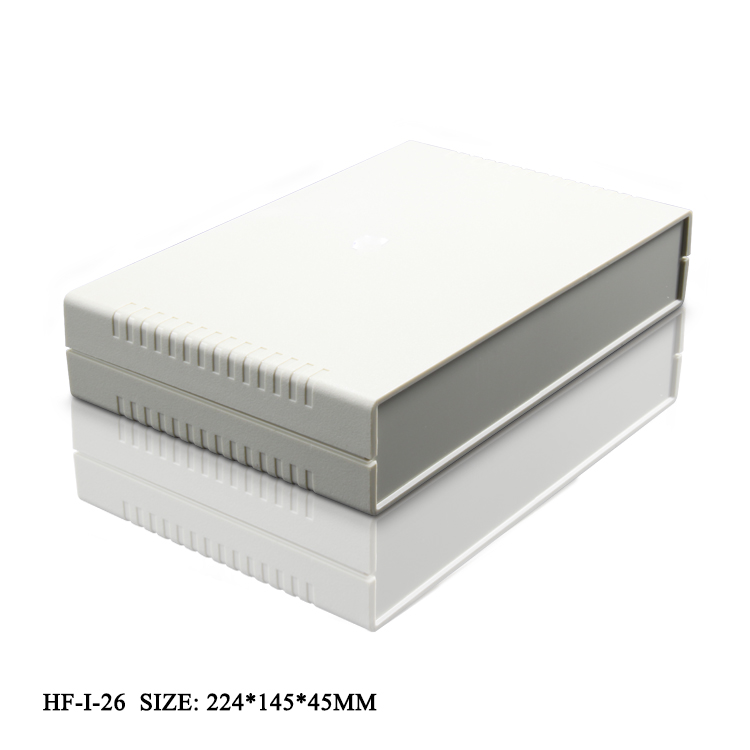
ABS plastic enclosures dominate indoor applications because they're cheap and easy to machine. Polycarbonate costs more but handles abuse better. PVC sits somewhere in the middle. Each material brings specific trade-offs that affect long-term performance.
Material | Impact Resistance | UV Stability | Temperature Range | Cost Factor |
ABS | Moderate | Poor | -20°C to 80°C | 1x (baseline) |
Polycarbonate | Excellent | Good | -40°C to 120°C | 2-3x |
PVC | Good | Moderate | -10°C to 60°C | 1.2-1.5x |
PC/ABS Blend | Very Good | Moderate | -30°C to 100°C | 1.8-2.2x |
● ABS plastic breaks down under direct sunlight within 12-18 months. You'll see surface chalking, color fading, and eventual cracking. Use ABS for climate-controlled spaces, indoor electrical panels, or covered outdoor locations with no UV exposure.
● Polycarbonate takes a beating and keeps working. Drop it, hit it with a hammer, expose it to weather – the material flexes and returns to shape. Custom electrical junction boxes made from polycarbonate cost more upfront but survive harsh conditions for years. The material resists chemicals well and maintains clarity if you need to see components inside.
● PVC offers chemical resistance that other plastics can't match. Acids, bases, and solvents that eat through ABS barely affect PVC. The material works great for chemical processing areas or agricultural applications where fertilizers and pesticides come into contact with enclosures.
● PC/ABS blends combine impact strength with better processability. Plastic junction box manufacturers can mold complex shapes and add features like snap-fits or living hinges. These custom plastic junction boxes balance performance and cost for mid-range applications.
Undersized plastic junction boxes create three problems: difficult wire management, heat buildup, and code violations. The National Electrical Code sets minimum volume requirements based on wire gauge and conductor count. You need room for connections, space for heat dissipation, and access for future maintenance.
Start with wire fill calculations. Count every conductor entering the box, including grounds. Each wire gauge requires specific volume allowances – 12 AWG needs 2.25 cubic inches per conductor, while 14 AWG needs 2.0 cubic inches. Multiply the conductor count by the per-wire volume, then add 25% for connections and wire nuts.
A standard 4" x 4" x 2" box provides 21 cubic inches. That accommodates nine 12 AWG conductors or ten 14 AWG conductors. Go bigger if you're installing devices, mounting terminal blocks, or adding automation components.
Component spacing matters for heat management. Power supplies, relays, and motor controls generate heat that needs somewhere to go. Leave 2-3 inches of clearance around heat-generating components. Mount components vertically when possible to create convection flow.
Size up one step larger than calculated minimums. That extra space makes installation easier, prevents wire damage during termination, and gives you flexibility for future additions. A $12 difference in box cost beats tearing out an undersized installation later.
Heat kills plastic enclosures slowly. Cold makes them brittle. Chemicals attack from the outside in. You need to match material properties to your environment, or you'll replace boxes every few years.
Standard ABS plastic enclosure boxes work fine from -20°C to 80°C. Push beyond that range and you'll see warping, cracking, or complete failure. Cold temperatures below -20°C make ABS brittle – a minor impact shatters the housing. High temperatures above 80°C cause dimensional changes that break gasket seals.
Polycarbonate extends the operating range to -40°C up to 120°C. The material maintains flexibility at low temperatures and structural integrity at high temperatures. Custom aluminum enclosure alternatives handle even wider ranges, but metal brings its own challenges with condensation and grounding requirements.
Chemical exposure requires material-specific testing. Generic compatibility charts give you a starting point, but real-world conditions involve multiple chemicals, temperature variations, and concentration changes. Test samples in your actual environment before committing to large orders.
Common chemical interactions to watch:
● Hydrocarbons (oils, fuels, solvents) – Swell and weaken ABS, attack polycarbonate over time, PVC holds up best
● Acids and bases – PVC excels here, polycarbonate is acceptable, ABS fails quickly
● Alcohols – Most plastics handle methanol and ethanol, but isopropanol attacks polycarbonate
● Cleaning agents – Alkaline cleaners degrade ABS; avoid ammonia-based products with polycarbonate
Temperature cycling accelerates chemical damage. A box that survives continuous exposure to a mild acid at 20°C might fail within months if temperatures swing between 5°C and 45°C daily. The expansion and contraction pump chemicals into microscopic cracks.
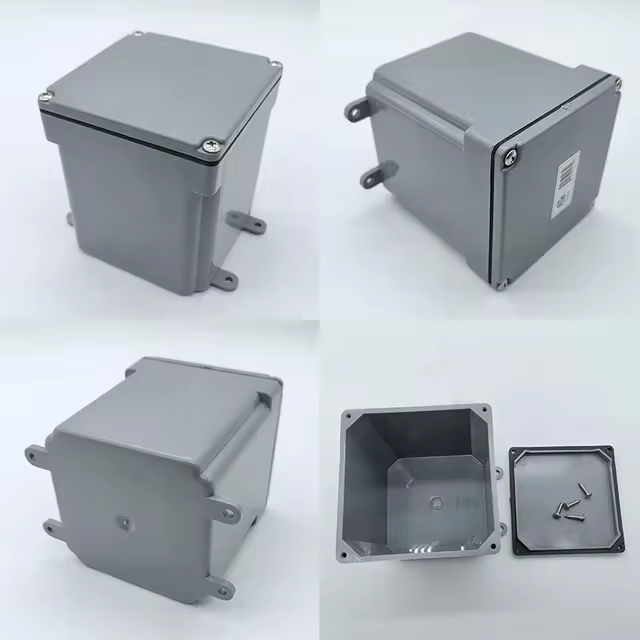
Wall-mounting a waterproof plastic junction box sounds simple until you're holding 50 pounds of wire and components. The mounting method affects installation time, long-term reliability, and modification flexibility. Pick the wrong approach, and you'll spend hours fighting gravity.
● Flange mounting puts threaded holes around the box perimeter. You drill matching holes in the wall or panel, insert the box, and bolt it down. This method distributes load evenly and creates a tight seal against the mounting surface. Use flange mounting for sheet metal enclosure boxes or when you need a clean, professional appearance.
● Keyhole slots speed up installation on drywall or wood surfaces. Mount the screws to the wall first, then slide the box onto the screw heads. The method works great for lightweight plastic enclosures under 5 pounds, but larger boxes need additional support.
● DIN rail mounting transforms junction boxes into modular components. The box snaps onto standard 35mm DIN rail inside panels or cabinets. You can reposition boxes quickly during installation or system modifications. This mounting style works well for control panels with multiple custom electrical junction boxes.
● Direct surface mounting uses the box's back panel as the mounting surface. Pre-molded standoffs create space for wiring behind the box. Drill through marked holes, insert anchors, and screw the box directly to concrete, brick, or metal. The method provides maximum strength for heavy installations.
Add vibration dampening for motor control applications or locations with constant mechanical movement. Rubber grommets between the box and mounting surface absorb vibration that would otherwise crack plastic over time. The grommets cost pennies but extend box life by years.
A $15 plastic enclosure box might cost you $200 in total installation expenses. A $45 custom junction box could save $500 in labor and downtime. Smart purchasing means calculating the total cost of ownership, not comparing price tags.
Material costs break down predictably. Standard abs plastic junction boxes start at $8-$12 for basic 6" x 6" sizes. Polycarbonate versions of the same size run $18-$30. Custom plastic junction boxes with special cutouts, mounting features, or oversized dimensions add $20-$50 to base prices. Sheet metal enclosure manufacturers charge $40-$100 for comparable metal options.
Installation labor dwarfs material costs. A pre-cut custom electrical junction box with cable entry points saves 30-45 minutes per installation compared to field-drilling standard boxes. At $75/hour labor rates, that's $37-$56 in saved time. Order 20 boxes for a project, and you've covered the customization premium.
Replacement costs hit harder than initial purchase prices. A $10 box that fails after two years costs $10 in materials plus $75-$150 in labor to replace, rewire, and test. A $35 box that lasts ten years costs $3.50 per year. Divide the purchase price by the expected service life to find the real cost.
Application-specific cost optimization:
● Indoor control panels – Standard ABS boxes work fine; spend money on proper sizing instead
● Outdoor installations – Invest in polycarbonate or PC/ABS blends with high IP ratings
● Harsh chemical environments – PVC costs more but eliminates replacement cycles
● High-vibration areas – Upgrade to impact-resistant materials and proper mounting hardware
Volume discounts kick in around 25-50 units. Custom sheet metal enclosures become cost-competitive with plastic at higher quantities (100+ units). Factor in lead times too – standard plastic junction boxes ship in days, while custom aluminum enclosure orders take 4-8 weeks.
You now have the framework to select plastic enclosures that match your requirements instead of guessing based on price alone. IP ratings, material properties, sizing calculations, and mounting methods all work together to determine long-term performance. The $20 you save on a cheaper box often turns into $200 in replacement costs when it fails prematurely.
Key takeaways to guide your selection:
● Match IP ratings to actual environmental conditions, not worst-case scenarios you'll never encounter
● ABS works indoors, polycarbonate handles outdoor abuse, and PVC resists chemicals
● Calculate wire fill requirements and size up one step for easier installation
● Test materials against your specific chemicals and temperature ranges before bulk orders
● Factor installation labor and replacement costs into total ownership calculations
Most suppliers offer sample testing programs before you commit to production quantities. Companies like Shenzhen Hongfa Shunda Mould Co., Ltd provide custom plastic junction boxes, aluminum enclosures, and sheet metal solutions with material testing support. Request samples that match your environmental conditions and run them through accelerated aging tests.
The right plastic junction box protects your installation for years. The wrong one creates headaches, callbacks, and budget overruns. Use these selection criteria to make informed decisions that balance performance against cost.
