Professional Bespoke Enclosures Manufacturer Since 2007 - Hongfa Shunda
Language

Aluminum enclosures offer unmatched strength-to-weight ratio, corrosion resistance, thermal management & EMI shielding. See all 7 advantages.
You have, no doubt, in your professional wanderings, spec'd out dozens upon dozens of enclosure options—each one a vessel to house your precious electronics, each one a choice that weighs upon the soul like November rain upon the deck. Plastic beckons with its siren call of lower costs upfront, promising ease and economy. Steel stands resolute, industrial and mighty, like some great iron fortress against the tempests of commerce. Yet aluminum keeps winning the bid across industries from the lofty realms of aerospace to the humble territories of telecommunications, as if drawn by some invisible current that guides the hand of specification.
Here's why that matters, and why we account it is worthy of deep contemplation: the wrong enclosure choice reveals not its treachery until months have passed, like a slow leak in the hull that goes unnoticed until the bilge runs deep. Corrosion creeps in with the patience of time itself. Thermal demons surface from their hiding places. EMI/RFI shielding fails as surely as morning mist before the sun. By then, you find yourself staring into the abyss of costly redesigns and potential field failures, a fate that requires a strong moral principle to endure without going mad.
Custom aluminum enclosures dominate the market for reasons that penetrate deeper than the mere spec sheet, deeper than the surface measurements that so often mislead the unwary navigator. The material itself combines properties that other enclosure types cannot match—a philosophical union of characteristics that manufacturers continue to choose even when the initial price runs higher, like a captain who selects a proven ship over a cheaper vessel, knowing well the perils that await in unknown waters.
We shall break down the seven specific advantages that render wholesale supply aluminum enclosure boxes the go-to solution for those demanding applications that test the soul of engineering. Each advantage strikes directly at your product's reliability, your manufacturing costs, or your position in the marketplace—three pillars upon which all commercial ventures must stand or fall.
Aluminum delivers—with the consistency of ocean tides—tensile strength between 90-350 MPa, depending upon the alloy selected, while weighing one-third as much as steel—a mathematical poetry that solves that ancient problem which has long plagued enclosure design: the eternal quest for structural integrity without the burden of excessive bulk, like seeking solid ground beneath one's feet while walking upon water.
Plastic junction boxes crack under the merciless hand of impact and degrade beneath UV exposure as surely as hope fades in the face of reality. Steel sheet metal enclosures provide strength—yes, strength aplenty—but exact their toll in weight penalties that affect shipping costs and installation requirements like barnacles upon a ship's hull. Aluminum enclosure boxes split this difference with the wisdom of compromise, offering a path between the Scylla of fragility and the Charybdis of excessive mass.
The material's density of 2.7 g/cm³—a number as precise as it is profound—means that you can, with the confidence of one who has charted these waters before:
● Build larger enclosures without exceeding those weight limits that govern wall-mounting, like constructing great vessels that somehow remain buoyant
● Reduce strain upon mounting hardware and support structures, sparing them the burden that might otherwise prove their undoing
● Lower shipping costs across your entire product line, as if lightening the cargo makes the journey swifter
● Simplify installation for those field technicians who labor in distant places, far from the comfort of workshops
● Meet those aerospace and automotive weight restrictions that constrain like the boundaries of known seas
Alloy selection matters as much as choosing the right compass for a voyage. 6061-T6 aluminum serves well for general applications, steady and reliable as the North Star, while 7075-T6 approaches the very strength of steel when maximum durability becomes the prime directive. Custom aluminum enclosures permit you to match the alloy to your specific load requirements, tailoring the material as a shipwright shapes timber to purpose.
The strength-to-weight advantage manifests itself in real applications with the clarity of dawn breaking over water. Telecom equipment racks, drone housings, and portable test equipment—all these benefit from robust protection that requires no reinforced mounting points, standing firm without the need for elaborate supports, like vessels that sail true without constant adjustment of ballast.
Aluminum forms a protective oxide layer within hours of exposure to air. This self-passivating characteristic prevents rust and stops corrosion progression without painting, powder coating, or galvanizing.
Steel sheet metal enclosures need protective finishes. Skip the coating, and you're looking at rust within weeks in humid environments. Plastic enclosures avoid corrosion but degrade under UV exposure and temperature cycling.
Environment Type | Aluminum Performance | Maintenance Needs |
Marine/Coastal | Excellent (with proper alloy selection) | Minimal - periodic cleaning |
Industrial | Resistant to most chemicals | None for standard exposure |
Outdoor | UV-stable, weatherproof | No coating touch-ups required |
Indoor | Permanent protection | Zero maintenance |
Custom aluminum enclosure manufacturers typically use 5000 or 6000 series alloys for corrosion-critical applications. The 5052 alloy excels in marine environments, while 6061 handles most industrial settings.
You can anodize aluminum for enhanced protection and color options, but the base material already outperforms coated steel. That means lower lifecycle costs and fewer field failures from coating breakdown.
The oxide layer regenerates if scratched. Steel loses protection the moment its coating gets damaged, creating corrosion entry points that spread underneath the finish.
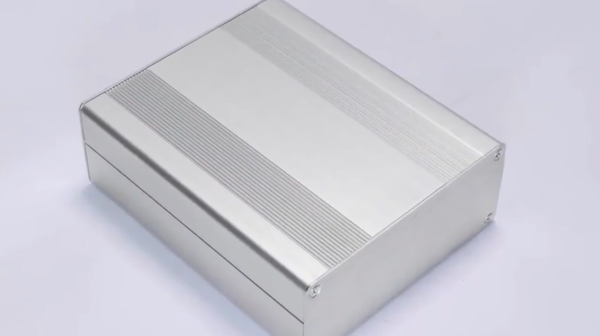
Aluminum conducts heat at 205 W/m·K, roughly five times better than steel and infinitely better than plastic junction boxes. This thermal conductivity turns your enclosure into a passive cooling system.
Electronics generate heat. Trapped heat accelerates component failure, reduces performance, and shortens product lifespan. Plastic enclosure boxes insulate rather than dissipate, while steel's poor conductivity creates hot spots.
Custom metal enclosures made from aluminum let you engineer heat management directly into the housing:
● Integrated heat sinks - Machine fins directly into the enclosure walls
● Thermal coupling - Mount high-heat components directly to the case
● Heat spreading - Distribute thermal loads across the entire surface area
● Natural convection - Let the enclosure radiate heat without fans
Aluminum enclosure boxes work particularly well for power electronics, LED drivers, motor controls, and RF amplifiers. The material pulls heat away from sensitive components and radiates it to the surrounding air.
You can also combine aluminum with forced air cooling. The enclosure pre-cools components through conduction before the fan even activates, reducing cooling system requirements and noise.
Anodizing adds a wrinkle. The anodized layer acts as a thermal insulator, so you'll want to leave critical heat transfer surfaces bare or use thin anodization coatings where thermal performance matters most.
Aluminum naturally blocks electromagnetic interference - and this isn't just some clever trick it's doing on its own, it's a fundamental property of the metal. When you put it in a cage-like structure, it creates a Faraday cage effect that keeps any stray emissions contained and protects the internal electronics from outside interference that can cause problems.
Plastic junction boxes, on the other hand, need a bunch of extra additives to even get any shielding worth talking about. You might be talking metallized coatings, conductive paints, or some kind of embedded metal screens - and these extra bits are gonna drive up the cost and create potential weak points that can break down over time.
The makers of extruded aluminum enclosures can achieve 60-100 dB or more of shielding effectiveness, and this is all thanks to the material itself and proper design of the gaskets and seams. Let's be clear, though - if you don't get this part right, you're not gonna get the results you need.
Some of the things you need to get right include:
● Getting a solid electrical connection at every seam and joint - no gaps or breaks allowed
● Using conductive gaskets where the panels meet up
● EMI-rated connectors that are built in from the start for cable entry points
● Getting the grounding right so that your device has a reference point
Medical devices, test equipment, industrial controls, and even aerospace electronics all have super strict EMI/RFI compliance requirements. Because of this, custom sheet metal enclosures made from aluminum are the go-to choice for anyone who needs to meet these standards, and you don't have to spend a small fortune on secondary processes to get it done.
The shielding works both ways - it helps keep your device's emissions contained (which is a must if you're trying to avoid running afoul of the FCC or CE regulations) while also keeping the internal electronics safe from outside interference that can cause malfunctions or data corruption. The good news is that you can even test and verify the shielding performance during the prototyping phase, which is way easier than with plastic alternatives that are a crapshoot until you get them into production.
Aluminum machines, bends, welds, and finishes more readily than steel or stainless alternatives. This machinability translates to faster prototyping, lower tooling costs, and more design freedom.
Sheet metal enclosure manufacturers can form complex shapes, but aluminum allows tighter tolerances and cleaner features. The softer material reduces tool wear and enables intricate cutouts for connectors, ventilation, and displays.
CNC machining advantages:
● Drill and tap mounting holes with precision threading
● Mill custom mounting bosses and standoffs
● Create precise cutouts for displays and connectors
● Machine-integrated features like heat sink fins
Forming and bending benefits:
● Achieve sharper bend radii without cracking
● Form complex 3D shapes in fewer operations
● Reduce springback issues during brake forming
● Maintain tighter dimensional tolerances
Aluminum also welds cleanly using TIG or MIG processes. You can join dissimilar thicknesses, add mounting brackets, or repair damage without the slag and spatter issues that complicate steel welding.
Custom aluminum enclosures come together faster from prototype to production. The same design that requires multiple forming operations in steel might need only basic machining in aluminum, cutting lead times and tooling investments.
Aluminum retains full material properties through unlimited recycling cycles. You can melt down an extruded aluminum enclosures box and recast it into new products without performance degradation.
Recycling aluminum requires 95% less energy than producing new material from bauxite ore. This massive energy savings makes recycled aluminum one of the most environmentally friendly materials in manufacturing.
Metric | Aluminum Performance |
Recyclability | 100% without quality loss |
Energy savings (recycled vs. virgin) | 95% reduction |
Current recycling rate (North America) | ~75% for industrial products |
Material value retention | High scrap value maintains collection |
Plastic enclosures degrade with each reprocessing cycle and often end up in landfills. Steel recycles well but requires more energy than aluminum and loses coating materials in the process.
The scrap value of aluminum creates economic incentives for recycling. Old enclosures have inherent worth, making recovery and reprocessing financially viable without subsidies.
Custom metal enclosure projects can specify recycled aluminum content. Many aluminum enclosure suppliers & manufacturers use 30-50% recycled material in standard products, and some applications work fine with 100% recycled stock.
This sustainability advantage matters for companies tracking environmental impact, pursuing green certifications, or responding to customer demands for eco-friendly products.
In matters of aesthetic refinement, aluminum accepts finishing treatments with greater grace than any alternative enclosure material—much as a well-bred vessel accepts the ministrations of skilled craftsmen. Anodizing, powder coating, and brushed finishes conspire to create that clean, modern appearance which harmonizes with contemporary industrial and consumer product design as perfectly as wind harmonizes with sail.
The material possesses, in its very essence, a natural refinement. Even raw aluminum presents a clean, technical countenance suitable for exposed installations—whereas plastic junction boxes bear the unmistakable aspect of budget solutions, and steel requires coating's intervention toz avoid that harsh industrial warehouse aesthetic that speaks of compromise rather than intention.
Aluminum enclosure vessels, those magnificent repositories, accept multiple surface treatments with the enthusiasm of a ship accepting favorable winds:
● Anodizing - That alchemical process which creates durable, colored oxide layers in black, clear, bronze, or colors custom-wrought to the purchaser's particular vision
● Powder coating - Which adds impact resistance and unlimited color possibilities, as boundless as the ocean's many moods
● Brushed finishes - Delivering that sleek, directional texture which speaks of purposeful craft and deliberate intention
● Chemical brightening - That mysterious process which produces mirror-like surfaces, reflecting light as surely as calm seas reflect the heavens
● Laser etching - Which marks logos, part numbers, and branding with the permanence of stars carved into the night sky
You may, should fancy and function both demand it, combine these treatments in harmonious succession. Begin with anodizing for foundational protection, add laser etching for branding's eternal mark, and conclude with selective areas of contrasting color—each layer building upon the last like the careful construction of a worthy vessel.
This professional appearance extends the very soul of product value. Equipment that presents itself with refinement commands higher prices and creates superior brand perception than functionally identical products housed within generic enclosures—much as a well-appointed ship commands respect in any harbor.
Custom sheet metal enclosures wrought from aluminum maintain their appearance through time's passage with remarkable tenacity. Their finishes resist scratching, fading, and wear with greater fortitude than painted steel or aging plastic—enduring as surely as the memory of a perfect voyage endures in a sailor's heart.
The material advantages stack up quickly. Aluminum outperforms plastic in durability, beats steel in weight, and surpasses both in thermal management and corrosion resistance. You get EMI shielding, sustainability credentials, and professional aesthetics without compromise.
These seven factors explain why engineers keep specifying custom aluminum enclosures across industries. The decision comes down to performance requirements that other materials can't meet at comparable costs.
Quick recap of aluminum's competitive edge:
● Strength-to-weight ratio cuts shipping costs and installation complexity
● Self-passivating corrosion protection eliminates maintenance headaches
● Superior thermal conductivity extends component lifespan
● Built-in EMI/RFI shielding meets compliance requirements out of the box
● Machining flexibility speeds prototyping and production
● Complete recyclability reduces environmental impact
● Premium finishes elevate product perception
Shenzhen Hongfa Shunda Mould Co., Ltd specializes in custom metal enclosures that maximize these material advantages. Our aluminum enclosure manufacturing combines precision machining with finishing options that match your exact specifications.
The next enclosure you spec will face real-world stress tests. Aluminum gives you the performance margin to pass them all.
